Between the Shelves: TV Shows and Movies Set in Bookstores and Libraries

Bookstores and libraries hold a kind of magic that’s hard to explain to someone who hasn’t felt it—that particular hush when you walk through the door, the scent of paper both new and worn, the sense that every shelf holds a world waiting to open up. It’s no wonder filmmakers and television writers keep returning to these spaces, again and again, as settings for their most memorable stories.
We’ve already explored movies and TV shows based on books, but this is something a little different: stories set inside the places where literature lives. Whether the backdrop is a cluttered London bookshop or a grand public library housing magical artifacts, these settings do something special. They turn a physical space into a character of their own.
Here at the Friends of the Chelsea Public Library, we believe in the power of books and the spaces that hold them. 100% of proceeds from our monthly book sales go directly back to library programs and resources. So yes, we have a soft spot for any story that celebrates what libraries and bookstores mean to a community. Let’s dive in.
Why Do Books and Libraries Make Such Powerful Settings?
Before we get into the shows and films themselves, it’s worth asking why these spaces work so well on screen. And the answer goes deeper than aesthetics.
Research consistently shows that home literacy environments (i.e., spaces filled with books) shape educational development in meaningful ways. Children who grow up surrounded by books demonstrate stronger literacy skills, broader vocabularies, and improved academic performance, even when accounting for other socioeconomic factors.
The presence of books creates what researchers call a “scholarly culture,” where reading becomes normalized and curiosity is encouraged. That effect doesn’t stop at childhood, either. Adults who maintain personal libraries report higher levels of lifelong learning and intellectual engagement.
For screenwriters, these spaces come loaded with built-in symbolism. Libraries represent order, preserved knowledge, and public service—institutions that belong to everyone. Bookstores can embody the tension between commerce and art, between independent spirit and corporate influence.
Books themselves offer endless opportunities for parallel storytelling: a character’s reading choices can reveal their inner life, and literary references can foreshadow plot twists or illuminate themes without a single word of heavy-handed exposition.
Feeling Inspired?
If you’re inspired to create your own literary sanctuary at home, our guide on how to build a home library on a budget is a great place to start.
What Are the Best Movies Set in Bookstores?
Some of the most beloved films of the past few decades have centered their stories around bookstores—and not just as backdrops, but as emotional and narrative engines.
You’ve Got Mail (1998)

Nora Ephron’s romantic comedy places Kathleen Kelly (Meg Ryan) at the heart of a charming children’s bookshop called “The Shop Around the Corner,” pitted against Joe Fox’s (Tom Hanks) corporate chain “Fox Books.”
The intimate, carefully curated neighborhood bookstore versus the sprawling superstore captures real tensions that independent booksellers were living through in the late 1990s (and that many still navigate today).
Through Kathleen’s passionate defense of her shop, viewers are reminded of the personal connection that small bookstores foster between books and their readers. It’s safe to say this theme resonates even more strongly in today’s era of online shopping and e-readers.
Notting Hill (1999)

In true '90s romcom fashion, Hugh Grant’s William Thacker runs a shop that only sells travel books in London’s picturesque Notting Hill neighborhood.
It’s a detail that functions as a quiet metaphor: William has surrounded himself with stories of journeys while his own life has quietly stalled.
When a famous actress (Julia Roberts) unexpectedly walks through his door, the bookshop becomes the unlikely launching point for an adventure he never anticipated.
The Bookshop (2017)

Set in 1959, this period drama starring Emily Mortimer tells the story of Florence Green, a widow who decides to open a bookshop in a small English coastal town despite local opposition.
Through Florence’s determination to bring books like “Lolita” to her conservative community, the film explores how bookshops can challenge social norms and serve as quiet beacons of intellectual freedom.
The beautiful cinematography captures both the physical coziness of the bookshop and the emotional solace it provides to those who understand its value.
Can You Ever Forgive Me? (2018)

Based on a true story, "Can You Ever Forgive Me?" stars Melissa McCarthy as Lee Israel, a biographer who turns to literary forgery when her career falters.
New York’s used bookstores and rare book dealers become essential to both the plot and atmosphere of the film, as Israel navigates this world to sell her increasingly convincing forgeries of letters by famous authors.
The film captures the sometimes dusty, sometimes glamorous world of literary memorabilia and rare books in 1990s New York, showing how bookstores serve not just as retail spaces but as archives of literary history and connections to writers of the past.
Stranger Than Fiction (2006)

Will Ferrell plays Harold Crick, an IRS auditor who begins hearing a voice narrating his life. The film features Dustin Hoffman as literature professor Jules Hilbert, who helps Harold determine if he’s in a comedy or tragedy.
But more significantly, it includes a pivotal bookstore scene where Harold searches for the author whose voice he hears (Emma Thompson). As a result, the bookstore becomes a bridge between the fictional world and reality, between character and creator.
What makes "Stranger Than Fiction" particularly resonant is how it uses books and literature as more than setting; they become the very fabric of the narrative. The film explores the relationship between authors and their characters, the ethical implications of storytelling, and the power of literature to shape our understanding of life and death.
Eternal Sunshine of the Spotless Mind (2004)

While primarily known as a romantic drama with science fiction elements, this Michel Gondry film features one of the most memorable bookstore scenes in cinema.
As Joel (Jim Carrey) undergoes a procedure to erase memories of his relationship with Clementine (Kate Winslet), we witness a surreal sequence in a bookstore where the titles on the books begin to disappear as his memories fade.
The bookstore setting becomes a perfect metaphor for the film’s exploration of memory and identity. As Joel moves through the aisles, the books (i.e., repositories of stories and knowledge) literally lose their content, mirroring his own loss of precious memories. The contrast between a space designed to preserve stories and the deliberate destruction of Joel’s personal narrative creates one of the most poignant moments in the film.
What TV Shows Are Set in Libraries?
Television has found rich comedic and dramatic territory inside library walls.
Black Books

Created by Dylan Moran and Graham Linehan, "Black Books" is a BAFTA-winning series that centers on Bernard Black, possibly the world's most misanthropic bookseller.
His small London bookshop is less a commercial enterprise and more a fortress against the outside world—cluttered, dusty, and deliberately unwelcoming to actual customers.
The setting perfectly mirrors Bernard's cluttered mind and creates a brilliant contrast with his reluctant assistant Manny (Bill Bailey) and neighbor Fran (Tamsin Greig).
While most bookstore depictions emphasize warmth and knowledge, "Black Books" hilariously subverts expectations by showing what happens when someone who fundamentally dislikes people is nevertheless surrounded by the most human of creations.
Shelved (2023)

This Canadian workplace comedy set in the fictional Jameson Public Library in Parkdale brings a fresh take on the library setting.
The show follows idealistic new librarian Wendy (Dakota Ray Hebert) and her by-the-book manager Howard (Paul Braunstein) through the daily rhythms of a public library that serves as a true community hub.
What makes “Shelved” particularly engaging is how it uses the library setting to mirror neighborhood issues like budget cuts, unusual patron requests, shifting community needs while reminding viewers that modern libraries are far more than book repositories.
The Librarians (2014-2018) & The Librarian Film Series (2004-2008)

Then there’s the adventure franchise built entirely around a secret library. This series follows Flynn Carsen (Noah Wyle) and later a team of librarians who protect a secret branch of the Metropolitan Public Library that houses magical artifacts too dangerous for public knowledge.
The series cleverly extends the real-world concept of libraries as repositories of human knowledge.
However, that knowledge includes objects of extraordinary power, and the library itself contains portals to locations across the globe. It’s fantastical, yes, but at its core it celebrates something true: libraries preserve what matters most.
Aurora Teagarden Mysteries (2015-2025)

Based on the book series by Charlaine Harris (creator of the Sookie Stackhouse novels that inspired “True Blood”), the “Aurora Teagarden Mysteries” centers on a professional librarian with a passion for solving crimes.
Originally played by Candace Cameron Bure in the Hallmark Movies & Mysteries series and later by Skyler Samuels in a prequel, Aurora combines her research skills, attention to detail, and access to information to become an amateur sleuth in her small town.
Aurora’s position at the Lawrenceton Public Library puts her at the heart of her community, giving her unique insights that prove crucial time and again. The library provides her not just with research resources but also connects her to the “Real Murders Club,” a group of true crime enthusiasts who gather monthly to study famous cases. With over 20 film adaptations as of 2025, the series demonstrates the enduring appeal of a bookish protagonist using her knowledge to unravel mysteries.
Mystery Woman (2003-2007)

This Hallmark Channel mystery movie series stars Kellie Martin as Samantha Kinsey, a bookstore owner with a knack for solving crimes.
After inheriting a mystery bookstore aptly named “Mystery Woman,” Samantha finds herself drawn into real-life mysteries that mirror the plots of the books she sells.
The bookstore also houses a secret passage and hidden room (a former speakeasy), adding another layer of mystery to the setting itself.
Bookish (2023-present)

Centered on The Anthology Bookstore, a struggling independent shop in a gentrifying neighborhood, the series weaves together the lives of staff and regular customers as they navigate financial pressures and shifting community dynamics.
What sets it apart is how books themselves actively influence the storylines.
Characters find themselves reading novels that mysteriously parallel their current situations, and the bookstore becomes almost a character in its own right, drawing people together and inspiring connections through shared literary experience.
Are There Any Animated Films Featuring Libraries?
Absolutely! And some of the most iconic characters in cinema history happen to be librarians.
Beauty and the Beast (1991)

One of the most iconic library scenes in cinema comes from this Disney animated classic.
When the Beast reveals his enormous castle library to Belle, her wonder—that breathless moment of taking in shelf after towering shelf—captures exactly how many book lovers feel when they encounter a truly extraordinary collection.
The library serves multiple storytelling purposes at once: it establishes Belle as a reader in a town that finds her strange for it, it reveals the Beast’s hidden depths, and it provides common ground for an unlikely connection. The library, in other words, becomes a symbol of possibility, of the worlds that open up when two people share what they love.
Read or Die (anime series)

The Japanese anime “Read or Die” takes bibliophilia to superhuman extremes. Protagonist Yomiko Readman is a special agent for the British Library Special Operations Division whose power is the ability to manipulate paper—turning it into weapons, shields, and tools.
The series presents a world where books literally contain power, celebrating the magical potential of literature while delivering action sequences that would make any book lover cheer. It’s perhaps the most literal interpretation of what books can do in any visual medium.
Want to bring more books into your life?
Our book sales support the library programs that keep our community connected to literature. See how your purchase makes a difference
Which Real Bookstores Have Been Used as Movie Filming Locations?
Some real-world bookstores and libraries have become cinematic landmarks in their own right. These spaces are so visually and historically rich that they attract filmmakers the way they attract readers.
The Livraria Lello in Porto, Portugal

Often cited as an inspiration for the moving staircases and gothic atmosphere of Hogwarts in the Harry Potter films, this stunning bookstore features a red staircase and stained glass ceiling.
As a result, it's one of the most photographed bookstores in the world, drawing hundreds of thousands of visitors annually who come as much for the architecture as for the books.
Shakespeare and Company in Paris
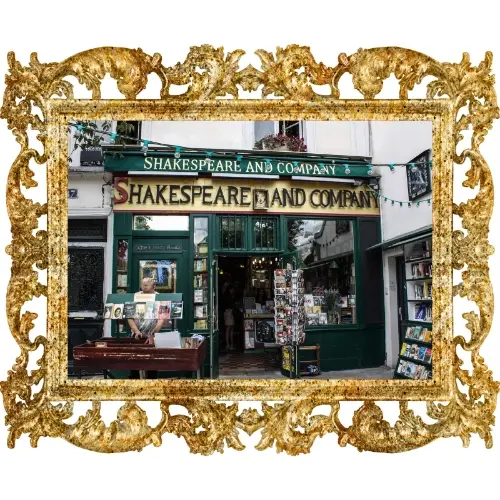
Featured prominently in “Before Sunset” (2004), where Jesse (Ethan Hawke) gives a book reading, this legendary bookstore has a rich history as a gathering place for literary expatriates—Hemingway, Joyce, and countless others passed through its doors.
Shakespeare and Company continues to allow young writers to stay in the shop in exchange for helping around the store, just as it did in the days of the Lost Generation.
The New York Public Library

This iconic literary institution has appeared in countless productions, from the opening scene of “Ghostbusters” (1984), where the team encounters their first supernatural entity, a ghostly librarian haunting the stacks, to the wedding scene in “Sex and the City: The Movie” (2008).
The library’s grandeur, with its vast reading rooms and labyrinthine stacks, makes it the perfect setting for everything from paranormal encounters to romantic moments.
Its lion statues and grand Reading Room are instantly recognizable to audiences worldwide, which is why directors keep returning to it as a visual shorthand for New York’s intellectual and cultural life.
What Do These Stories Tell Us about Books and Community?
Every film and show on this list is, at its heart, about the same thing: connection. Take "The Guernsey Literary and Potato Peel Pie Society" (2018), for example.
Set during the German occupation of Guernsey in World War II, the film follows writer Juliet Ashton (Lily James) as she learns about a book club formed during the occupation, where reading together became an act of resistance and a source of comfort during impossible times.
Books and the act of sharing them forged unexpected bonds between people from entirely different backgrounds. The film illustrates beautifully how literature creates community, and how a shared story can sustain people through darkness.
And that's what our community at the Friends of the Chelsea Public Library experiences every second Saturday of the month (unless otherwise noted). People come for the books, but they stay for the conversation, the discovery, the sense of being part of something larger than themselves (and maybe for Lori's impromptu singing).
Why These Stories Matter
From Bernard Black’s chaotic London bookshop to the magical library of “The Librarian,” bookstores and libraries continue to provide rich settings for visual storytelling across genres. These literary spaces offer unique possibilities for character development, plot advancement, and thematic exploration that few other settings can match.
As our relationship with physical books evolves with the rise of e-books and technology, these depictions take on new significance, sometimes nostalgic, sometimes reimagining what these spaces can be. What remains constant is the enduring appeal of places dedicated to stories—both the ones on the shelves and the ones that unfold between the people who visit.
The next time you walk into your local bookstore or library, take a moment to look around. Notice who else is there, what they’re reaching for, what expression crosses their face when they find something unexpected. Every book lover knows that the most interesting stories sometimes happen not just within the pages, but between them.
Come to Our Next Used Book Sale!
Friends of Chelsea Library is proud to support literacy and community engagement through our book sales and events. Check out our upcoming sales to find your next great read!
Friends of Chelsea Library is a non-profit organization dedicated to supporting the Chelsea Public Library through fundraising, advocacy, and volunteer service. 100% of proceeds from our book sales directly benefit library programs and resources that serve our community.


Comments